What was the total number of stars received by D?
Solution
Every blogger received .
Answer: 45
Assigning people, items or values to one another under conditions.
Appeared in 5 of 18 slots. Most recent: CAT 2024 Slot 1.
| Year | Slot 1 | Slot 2 | Slot 3 | Sets |
|---|---|---|---|---|
| CAT 2025 | 0 | 0 | 0 | 0 |
| CAT 2024 | 1 | 1 | 0 | 2 |
| CAT 2023 | 0 | 0 | 0 | 0 |
| CAT 2022 | 1 | 0 | 0 | 1 |
| CAT 2021 | 1 | 1 | 0 | 2 |
| CAT 2020 | 0 | 0 | 0 | 0 |
| Total | 3 | 2 | 0 | 5 |
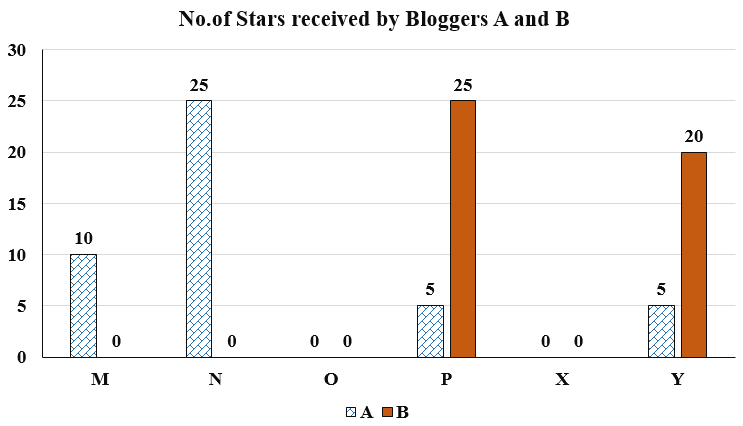
Six web surfers M, N, O, P, X, and Y each had 30 stars which they distributed among four bloggers A, B, C, and D. The number of stars received by A and B from the six web surfers is shown in the figure below.
The following additional facts are known regarding the number of stars received by the bloggers from the surfers.
1. The numbers of stars received by the bloggers from the surfers were all multiples of 5 (including 0).
2. The total numbers of stars received by the bloggers were the same.
3. Each blogger received a different number of stars from M.
4. Two surfers gave all their stars to a single blogger.
5. D received more stars than C from Y.
A and B each received 45, so every blogger received 45 (total 180). C and D share: M 20, N 5, O 30, P 0, X 30, Y 5.
From Y, D gets more than C, so D 5 and C 0.
Two surfers gave all their stars to one blogger; only O and X can (30 each to C or D). They can't both go to the same blogger (60 > 45), so one goes to C and one to D.
C: . M's four amounts are distinct (A 10, B 0), so , which forces , . Then , .
What was the total number of stars received by D?
Every blogger received .
What was the number of stars received by D from Y?
D received from Y (C received 0).
How many surfers distributed their stars among exactly 2 bloggers?
N (A, D) and P (A, B) use exactly two bloggers: .
Which of the following can be determined with certainty?
I. The number of stars received by C from M
II. The number of stars received by D from O
C from M is 15 for certain. D from O is 30 or 0 depending on whether O or X chose D. Only I.
Eight gymnastics players numbered 1 through 8 underwent a training camp where they were coached by three coaches - Xena, Yuki, and Zara. Each coach trained at least two players. Yuki trained only even numbered players, while Zara trained only odd numbered players. After the camp, the coaches evaluated the players and gave integer ratings to the respective players trained by them on a scale of 1 to 7, with 1 being the lowest rating and 7 the highest.
The following additional information is known.
1. Xena trained more players than Yuki.
2. Player-1 and Player-4 were trained by the same coach, while the coaches who trained Player-2, Player-3 and Player-5 were all different.
3. Player-5 and Player-7 were trained by the same coach and got the same rating. All other players got a unique rating.
4. The average of the ratings of all the players was 4.
5. Player-2 got the highest rating.
6. The average of the ratings of the players trained by Yuki was twice that of the players trained by Xena and two more than that of the players trained by Zara.
7. Player-4's rating was double of Player-8's and less than Player-5's.
Player 4 is even (Xena or Yuki) and Player 1 is odd (Xena or Zara), so both are with Xena. Players 2, 3 and 5 have different coaches: Player 2 must be Yuki's, and Players 3 and 5 split Xena and Zara.
Ratings: Players 5 and 7 share a rating and all others differ, so all of 1–7 appear. Total .
Player 2 has the top rating, 7. Player 4 Player 8 and is below 4, so Player 4 , Player 8 . Players 1, 3 and 6 share 3, 5 and 6.
If Player 5 (and 7) were with Xena, Zara would have only Player 3. So Zara has Players 5 and 7 (average 4), Yuki's average is 6 and Xena's is 3.
Yuki: Player 2 (7) and Player 6 (5), average 6. Xena: Players 1, 3, 4, 8 with Players 1, 3 rated 3 and 6 in some order (average 3).
What best can be concluded about the number of players coached by Zara?
Zara coached Players 5 and 7 only: exactly .
What was the rating of Player-7?
Player 7's rating .
What was the rating of Player-6?
Yuki's average must be 6 with Player 2 at 7, so Player 6 .
For how many players the ratings can be determined with certainty?
Known: Players 2, 4, 5, 6, 7, 8. Players 1 and 3 can swap 3 and 6. Answer: .
Who all were the players trained by Xena?
Xena trained Players 1, 3, 4 and 8.
Adhara, Bithi, Chhaya, Dhanavi, Esther, and Fathima are the interviewers in a process that awards funding for new initiatives. Every interviewer individually interviews each of the candidates individually and awards a token only if she recommends funding. A token has a face value of 2, 3, 5, 7, 11, or 13. Each interviewer awards tokens of a single face value only.
Once all six interviews are over for a candidate, the candidate receives a funding that is Rs.1000 times the product of the face values of all the tokens. For example, if a candidate has tokens with face values 2, 5, and 7, then they get a funding of Rs.1000 × (2 × 5 × 7) = Rs.70,000.
Pragnyaa, Qahira, Rasheeda, Smera, and Tantra were five candidates who received funding. The funds they received, in descending order, were Rs.390,000, Rs.210,000, Rs.165,000, Rs.77,000, and Rs.66,000.
The following additional facts are known:
1. Fathima awarded tokens to everyone except Qahira, while Adhara awarded tokens to no one except Pragnyaa.
2. Rashida received the highest number of tokens that anyone received, but she did not receive one from Esther.
3. Bithi awarded a token to Smera but not to Qahira, while Dhanavi awarded a token to Qahira but not to Smera.
Fundings in thousands: , , , , .
Each prime appears at most once per candidate, so each interviewer has a different value.
Fathima gives to four candidates (all but Qahira): only 3 is in four amounts, so Fathima and Qahira .
Adhara gives to Pragnyaa only: only 13 appears once, so Adhara and Pragnyaa .
Rasheeda has the most tokens (4): Rasheeda . Smera and Tantra are 165 and 66.
Esther gave nothing to Rasheeda (2, 3, 5, 7), so Esther . Dhanavi gave to Qahira (7, 11), so Dhanavi . Bithi and Chhaya are 2 and 5 in some order.
| Candidate | Funding | Tokens |
|---|---|---|
| Pragnyaa | 390 | 4 |
| Rasheeda | 210 | 4 |
| Smera / Tantra | 165 or 66 | 3 |
| Qahira | 77 | 2 |
How many tokens did Qahira receive?
: tokens.
Who among the following definitely received a token from Bithi but not from Dhanavi?
Pragnyaa holds both 2 and 5, so she got Bithi's token whatever Bithi's value, and no 7 (Dhanavi). Rasheeda and Qahira got 7 from Dhanavi.
How many tokens did Chhaya award?
If Chhaya is 2: Pragnyaa, Rasheeda and the 66 candidate. If 5: Pragnyaa, Rasheeda and the 165 candidate. Either way .
How many tokens did Smera receive?
Smera has 165 or 66, both three tokens: .
Which of the following could be the amount of funding that Tantra received?
(a) Rs. 66,000
(b) Rs. 165,000
Bithi (2 or 5) gives to Smera, and either value fits. So Tantra could have 66 or 165: both.
A journal plans to publish 18 research papers, written by eight authors (A, B, C, D, E, F, G, and H) in four issues of the journal scheduled in January, April, July and October. Each of the research papers was written by exactly one of the eight authors. Five papers were scheduled in each of the first two issues, while four were scheduled in each of the last two issues. Every author wrote at least one paper and at most three papers. The total number of papers written by A, D, G and H was double the total number of papers written by the other four authors. Four of the authors were from India and two each were from Japan and China. Each author belonged to exactly one of the three areas — Manufacturing, Automation, and Logistics. Four of the authors were from the Logistics area and two were from the Automation area. As per the journal policy, none of the authors could have more than one paper in any issue of the journal.
The following facts are also known.
1. F, an Indian author from the Logistics area, wrote only one paper. It was scheduled in the October issue.
2. A was from the Automation area and did not have a paper scheduled in the October issue.
3. None of the Indian authors were from the Manufacturing area and none of the Japanese or Chinese authors were from the Automation area.
4. A and H were from different countries, but had their papers scheduled in exactly the same issues.
5. C and E, both Chinese authors from different areas, had the same number of papers scheduled. Further, E had papers scheduled in consecutive issues of the journal but C did not.
6. B, from the Logistics area, had a paper scheduled in the April issue of the journal.
7. B and G belonged to the same country. None of their papers were scheduled in the same issue of the journal.
8. D, a Japanese author from the Manufacturing area, did not have a paper scheduled in the July issue.
9. C and H belonged to different areas.
A, D, G, H wrote 12 papers and the other four wrote 6. With at most 3 each, A, D, G and H wrote 3 each.
A: no October, so January, April, July. H has the same issues. D: not July, so January, April, October.
F wrote 1, so with . E's papers are in consecutive issues (at least 2), so C E and B (April).
G avoids April (B's issue): January, July, October.
Issue slots left: January 1, April 1, July 1, October 1 (sizes 5, 5, 4, 4). E needs consecutive issues and C non-consecutive ones: E April and July, C January and October.
Countries: C, E China; D Japan; F India. B and G share a country; Japan can't take both, so B and G are Indian. A (Automation) can't be Japanese or Chinese, so A is Indian and H is Japanese.
Areas: Automation (only Indians) A and G. Logistics: B, F and two of C, E, H. C differs from E and from H, so C is Manufacturing and E, H are Logistics.
| Author | Country | Area | Issues |
|---|---|---|---|
| A | India | Automation | Jan, Apr, Jul |
| B | India | Logistics | Apr |
| C | China | Manufacturing | Jan, Oct |
| D | Japan | Manufacturing | Jan, Apr, Oct |
| E | China | Logistics | Apr, Jul |
| F | India | Logistics | Oct |
| G | India | Automation | Jan, Jul, Oct |
| H | Japan | Logistics | Jan, Apr, Jul |
What is the correct sequence of number of papers written by B, C, E and G, respectively?
B 1, C 2, E 2, G 3.
How many papers were written by Indian authors?
A 3 B 1 F 1 G 3 .
Which of the following statement(s) MUST be true?
Statement A: Every issue had at least one paper by author(s) from each country.
Statement B: Every issue had at most two papers by author(s) from each area.
Each issue has papers from India, Japan and China, so A holds. April has three Logistics papers (B, E, H), so B fails. Only Statement A.
Which of the following statements is FALSE?
January has only one Logistics paper (H), so C is false.
Which of the following statements is FALSE?
Manufacturing (C, D): January 2, April 1, July 0, October 2. D is false.
Which of the following is the correct sequence of number of papers by authors from Automation, Manufacturing and Logistics areas, respectively?
Automation , Manufacturing , Logistics .
Ten objects o1, o2, …, o10 were distributed among Amar, Barat, Charles, Disha, and Elise. Each item went to exactly one person. Each person got exactly two of the items, and this pair of objects is called her/his bundle.
The following table shows how each person values each object.
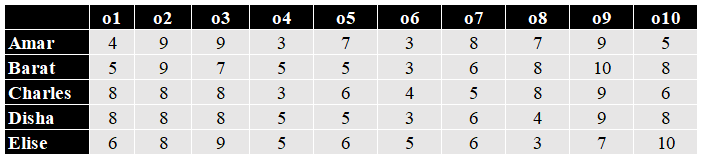
The value of any bundle by a person is the sum of that person’s values of the objects in that bundle. A person X envies another person Y if X values Y’s bundle more than X’s own bundle.
For example, hypothetically suppose Amar’s bundle consists of o1 and o2, and Barat’s bundle consists of o3 and o4. Then Amar values his own bundle at 4 + 9 = 13 and Barat’s bundle at 9 + 3 = 12. Hence Amar does not envy Barat. On the other hand, Barat values his own bundle at 7 + 5 = 12 and Amar’s bundle at 5 + 9 = 14. Hence Barat envies Amar.
The following facts are known about the actual distribution of the objects among the five people.
1. If someone’s value for an object is 10, then she/he received that object.
2. Objects o1, o2, and o3 were given to three different people.
3. Objects o1 and o8 were given to different people.
4. Three people value their own bundles at 16. No one values her/his own bundle at a number higher than 16.
5. Disha values her own bundle at an odd number. All others value their own bundles at an even number.
6. Some people who value their own bundles less than 16 envy some other people who value their own bundle at 16. No one else envies others.
Value-10 rule: Barat gets o9 and Elise gets o10.
Barat's bundle must be even and at most 16: (o7) is the only fit, so Barat has o9, o7 .
Elise: with o1 or o5 .
The third 16 must be Amar or Charles (Disha's value is odd). Charles reaches 16 only with two of his 8s (o1, o2, o3, o8); with o1, o2, o3 split up and o8 away from o1, that means o8 with o2 or o3.
Checking the remaining assignments against the envy rules (only people below 16 envy, and only people at 16) leaves one distribution:
| Person | Bundle | Own value |
|---|---|---|
| Amar | o2, o6 | 12 |
| Barat | o7, o9 | 16 |
| Charles | o3, o8 | 16 |
| Disha | o1, o4 | 13 |
| Elise | o5, o10 | 16 |
Amar envies Barat () and Charles (); Disha envies Barat ().
What BEST can be said about object o8?
o8 went to Charles.
Who among the following envies someone else?
Amar envies Barat and Charles.
What is Amar’s value for his own bundle?
Amar: .
Object o4 was given to
o4 went to Disha.
Object o5 was given to
o5 went to Elise.
What BEST can be said about the distribution of object o1?
o1 went to Disha.
Preparing for CAT seriously? Structured courses, live classes and mocks by Dr. Kiran Derle at Target Campus.
Explore courses ↗