What is the number of the chair initially occupied by Bashir?
Solution
Bashir started on chair .
Answer: 4
5 sets, 22 questions, in exam order.
A round table has seven chairs around it. The chairs are numbered 1 through 7 in a clockwise direction. Four friends, Aslam, Bashir, Chhavi, and Davies, sit on four of the chairs. In the starting position, Aslam and Chhavi are sitting next to each other, while for Bashir as well as Davies, there are empty chairs on either side of the chairs that are sitting on.
The friends take turns moving either clockwise or counterclockwise from their chair. The friend who has to move in a turn occupies the first empty chair in whichever direction (s)he chooses to move. Aslam moves first (Turn 1), followed by Bashir, Chhavi, and Davies (Turns 2, 3, and 4, respectively). Then Aslam moves again followed by Bashir, and Chhavi (Turns 5, 6, and 7, respectively).
The following information is known
1. The four friends occupy adjacent chairs only at the end of Turn 2 and Turn 6.
2. Davies occupies Chair 2 after Turn 1 and Chair 4 after Turn 5, and Chhavi occupies Chair 7 after Turn 2.
Davies is at chair 2 after Turn 1 and Chhavi at chair 7 after Turn 2. Neither has moved by then, so these are their starting chairs.
Davies has empty chairs on both sides, so chairs 1 and 3 are empty. Aslam sits next to Chhavi (7) but not at 1, so Aslam is at 6. Bashir needs empty chairs on both sides, which leaves chair 4 (3 and 5 empty).
Start: A6, B4, C7, D2 (empty: 1, 3, 5).
Turn 1: Aslam goes to 1 or 5. After Turn 2 all four must be adjacent; this works only if Aslam goes to 1 and Bashir to 3: chairs 7, 1, 2, 3.
Turn 3: Chhavi goes to 4 (clockwise) or 6 (counter-clockwise). Davies must reach chair 4 in Turn 4, so Chhavi goes to 6 and Davies moves clockwise to 4.
After Turn 4: A1, B3, C6, D4.
Turn 5: Aslam goes to 2 or 7. After Turn 6 all four are adjacent again; only Aslam to 7 and Bashir to 5 works: chairs 4, 5, 6, 7.
Turn 7: Chhavi leaves 6 (to 1 or 3). Bashir at 5 then has Davies (4) on one side and an empty chair (6) on the other.
What is the number of the chair initially occupied by Bashir?
Bashir started on chair .
Who sits on the chair numbered 4 at the end of Turn 3?
After Turn 3, Chhavi moved to chair 6 and Davies is still at 2, so chair 4 is empty: no one.
Which of the chairs are occupied at the end of Turn 6?
After Turn 6: Davies 4, Bashir 5, Chhavi 6, Aslam 7, i.e. chairs 4, 5, 6 and 7.
Which of the following BEST describes the friends sitting on chairs adjacent to the one occupied by Bashir at the end of Turn 7?
After Turn 7, Chhavi has left chair 6, so Bashir (chair 5) has only Davies (chair 4) next to him.
At InnovateX, six employees, Asha, Bunty, Chintu, Dolly, Eklavya, and Falguni, were split into two groups of three each: Elite led by Manager Kuku, and Novice led by Manager Lalu.
At the end of each quarter, Kuku and Lalu handed out ratings to all members in their respective groups. In each group, each employee received a distinct integer rating from 1 to 3.
The score for an employee at the end of a quarter is defined as their cumulative rating from the beginning of the year. At the end of each quarter the employee in Novice with the highest score was promoted to Elite, and the employee in Elite with the minimum score was demoted to Novice. If there was a tie in scores, the employee with a higher rating in the latest quarter was ranked higher.
1. Asha, Bunty, and Chintu were in Elite at the beginning of Quarter 1. All of them were in Novice at the beginning of Quarter 4.
2. Dolly and Falguni were the only employees who got the same rating across all the quarters.
3. The following is known about ratings given by Lalu:
• Bunty received a rating of 1 in Quarter 2.
• Asha and Dolly received ratings of 1 and 2, respectively, in Quarter 3.
Three swaps happen (after Q1, Q2 and Q3). For all of A, B, C to be in Novice at the start of Q4, every swap must demote one of A, B, C and promote one of D, E, F. So no one changes groups more than once.
Lalu rated Bunty in Q2 and Asha, Dolly in Q3, so: Bunty was demoted after Q1, Asha after Q2, Chintu after Q3; Dolly was in Novice through Q3 and was promoted after Q3.
Dolly got 2 in Q3 and her rating never changes, so she got 2 every quarter (score 6 after Q3).
Q1 (Novice D, E, F): Dolly 2, so the promoted employee got 3. In Q2 the Novice group is Bunty (1), Dolly (2) and the other of E/F (3). That employee must have got 1 in Q1 (Dolly had 2, the promoted one 3) and is promoted after Q2 on the tie-break (score 4 = Dolly's 4, but a higher latest rating). That employee's ratings change (1, 3), so it is Eklavya; Falguni (constant) got 3 every quarter.
Q2 Elite: Falguni 3, Asha and Chintu share 1 and 2, and Asha must have the lowest score. Checking the Q1 options (Asha 2/Chintu 3 or Asha 3/Chintu 2), Asha must get 1 in Q2 in both cases; her Q1 rating is not fixed.
Q3 Novice: Asha 1, Dolly 2, Bunty 3. Q3 Elite: Falguni 3; Chintu must be lowest, so Chintu gets 1 and Eklavya 2.
Scores after Q3: Asha 4 or 5, Bunty , Chintu 5 or 6, Dolly 6, Eklavya , Falguni 9.
What was Eklavya’s score at the end of Quarter 2?
Eklavya: 1 in Q1 and 3 in Q2, so the score is .
How many employees changed groups more than once up to the beginning of Quarter 4?
Every swap moves one of A, B, C down and one of D, E, F up, so no one changes groups twice: .
What was Bunty’s score at the end of Quarter 3?
Bunty: .
For how many employees can the scores at the end of Quarter 3 be determined with certainty?
Fixed scores: Bunty (5), Dolly (6), Eklavya (6), Falguni (9). Asha and Chintu depend on Q1. Answer: .
Which of the following statements is/are NECESSARILY true?
I. Asha received a rating of 2 in Quarter 1.
II. Asha received a rating of 1 in Quarter 2.
Asha's Q1 rating can be 2 or 3, but in every valid case she gets 1 in Q2. Only II is necessarily true.
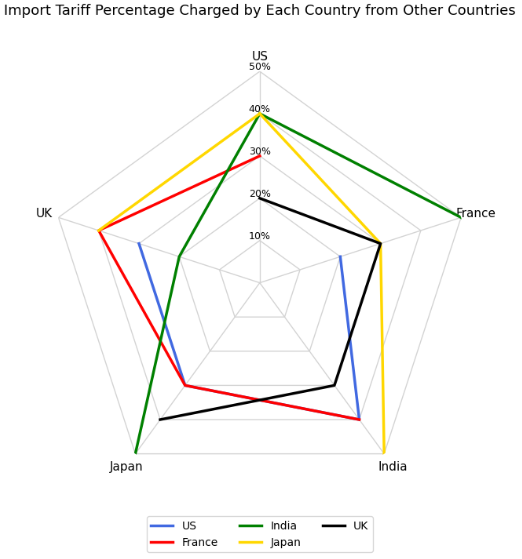
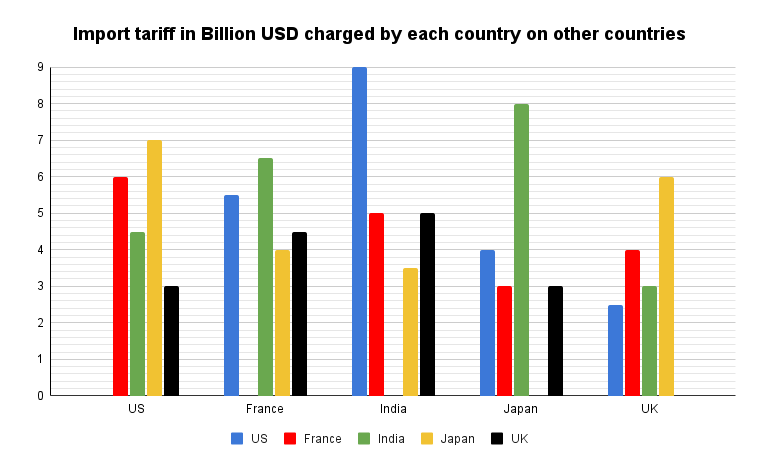
Five countries engage in trade with each other. Each country levies import tariffs on the other countries. The import tariff levied by Country X on Country Y is calculated by multiplying the corresponding tariff percentage with the total imports of Country X from Country Y.
The radar chart below depicts different import tariff percentages charged by each of the five countries on the others. For example, US (the blue line in the chart) charges 20%, 40%, 30%, and 30% import tariff percentages on imports from France, India, Japan, and UK, respectively. The bar chart depicts the import tariffs levied by each county on other countries. For example, US charged import tariff of 3 billion USD on UK.
Assume that imports from one country to another equals the exports from the latter to the former.
The trade surplus of Country X with Country Y is defined as follows.
Trade surplus = Exports from Country X to Country Y - Imports to Country X from Country Y.
A negative trade surplus is called trade deficit.
Imports of X from Y . Exports of Y to X are the same number.
Read the percentages from the radar chart (each country's line) and the tariff amounts from the bar chart (grouped by the country charging the tariff).
How much is Japan's export to India worth?
Japan's exports to India = India's imports from Japan billion USD.
Which among the following is the highest?
A: UK imports from Japan . B: US imports from France . C: Japan imports from France . D: France imports from India .
Highest: imports by US from France.
What is the trade surplus/trade deficit of India with UK?
India's exports to UK = UK's imports from India . India's imports from UK .
Trade surplus : a deficit of 15.0 billion USD.
Among France and UK, who has/have trade surplus(es) with US?
France: exports to US , imports from US , so a surplus.
UK: exports to US , imports from US , so a deficit.
Only France.
A train travels from Station A to Station E, passing through stations B, C, and D, in that order. The train has a seating capacity of 200. A ticket may be booked from any station to any other station ahead on the route, but not to any earlier station.
A ticket from one station to another reserves one seat on every intermediate segment of the route. For example, a ticket from B to E reserves a seat in the intermediate segments B - C, C - D, and D - E.
The occupancy factor for a segment is the total number of seats reserved in the segment as a percentage of the seating capacity. The total number of seats reserved for any segment cannot exceed 200.
The following information is known.
1. Segment C - D had an occupancy factor of 95%. Only segment B - C had a higher occupancy factor.
2. Exactly 40 tickets were booked from B to C and 30 tickets were booked from B to E.
3. Among the seats reserved on segment D - E, exactly four-sevenths were from stations before C.
4. The number of tickets booked from A to C was equal to that booked from A to E, and it was higher than that from B to E.
5. No tickets were booked from A to B, from B to D and from D to E.
6. The number of tickets booked for any segment was a multiple of 10.
Tickets that can be non-zero: A→C, A→D, A→E, B→C (40), B→E (30), C→D, C→E. (A→B, B→D, D→E are zero.)
Segment loads: A–B ; B–C ; C–D ; D–E .
Statement 3: , so and D–E .
is a multiple of 10 above 30 and must be divisible by 4: gives D–E ; gives 210 (too many). So , .
C–D: . B–C must exceed 190 and be at most 200, so and .
Loads: A–B 130, B–C 200, C–D 190, D–E 140.
What was the occupancy factor for segment D - E?
D–E has seats reserved: .
How many tickets were booked from Station A to Station E?
A→E .
How many tickets were booked from Station C?
From C: C→D C→E .
What is the difference between the number of tickets booked to Station C and the number of tickets booked to Station D?
To C: . To D: . Difference .
How many tickets were booked to travel in exactly one segment?
One-segment tickets: B→C (40) and C→D (20); A→B and D→E are zero. Total .
Alia, Badal, Clive, Dilshan, and Ehsaan played a game in which each asks a unique question to all the others and they respond by tapping their feet, either once or twice or thrice. One tap means “Yes”, two taps mean “No”, and three taps mean “Maybe”.
A total of 40 taps were heard across the five questions. Each question received at least one “Yes”, one “No”, and one “Maybe.”
The following information is known.
1. Alia tapped a total of 6 times and received 9 taps to her question. She responded “Yes” to the questions asked by both Clive and Dilshan.
2. Dilshan and Ehsaan tapped a total of 11 and 9 times respectively. Dilshan responded “No” to Badal.
3. Badal, Dilshan, and Ehsaan received equal number of taps to their respective questions.
4. No one responded “Yes” more than twice.
5. No one’s answer to Alia’s question matched the answer that Alia gave to that person’s question. This was also true for Ehsaan.
6. Clive tapped more times in total than Badal.
Each question gets four replies including at least one Yes (1), No (2) and Maybe (3), so it receives 7, 8 or 9 taps.
Received: Alia 9, and Badal = Dilshan = Ehsaan , Clive , with . Only , works.
Alia tapped 6 with Yes to Clive and Dilshan; she can't say Yes again, so she said No to Badal and Ehsaan.
Dilshan tapped 11 with No to Badal, so Maybe to the other three.
Statement 5 (Alia): the No to Alia's question came from Clive (Dilshan said Maybe), and her Yes came from Badal or Ehsaan.
Ehsaan tapped 9, and his reply to Dilshan cannot be Maybe (Dilshan told him Maybe), so it is No. Then his replies to Alia, Badal and Clive add to 7, which forces Maybe, Maybe, Yes.
That fixes: Badal → Alia Yes; Clive → Badal Yes; Badal → Clive No; Clive → Ehsaan No (it can't match Ehsaan's Yes to Clive); Badal → Ehsaan Yes.
Badal and Clive give No and Maybe to Dilshan. Clive taps more than Badal, so Clive says Maybe and Badal says No.
Totals tapped: Alia 6, Badal 6, Clive 8, Dilshan 11, Ehsaan 9.
How many taps did Clive receive for his question?
.
Which two people tapped an equal number of times in total?
Alia and Badal both tapped 6 times.
What was Clive’s response to Ehsaan’s question?
Clive answered No to Ehsaan's question.
How many “Yes” responses were received across all the questions?
Yes replies: Badal→Alia, Clive→Badal, Alia→Clive, Ehsaan→Clive, Alia→Dilshan, Badal→Ehsaan. Total .
Preparing for CAT seriously? Structured courses, live classes and mocks by Dr. Kiran Derle at Target Campus.
Explore courses ↗