What is the PI of Whimshire?
Solution
Whimshire: .
Answer: 45
Number-driven sets: equations, ratios, maxima and minima.
Appeared in 9 of 18 slots. Most recent: CAT 2025 Slot 2.
| Year | Slot 1 | Slot 2 | Slot 3 | Sets |
|---|---|---|---|---|
| CAT 2025 | 0 | 1 | 1 | 2 |
| CAT 2024 | 1 | 0 | 1 | 2 |
| CAT 2023 | 0 | 1 | 0 | 1 |
| CAT 2022 | 0 | 1 | 1 | 2 |
| CAT 2021 | 1 | 0 | 0 | 1 |
| CAT 2020 | 1 | 0 | 0 | 1 |
| Total | 3 | 3 | 3 | 9 |
The two most populous cities and the non-urban region (NUR) of each of three states, Whimshire, Fogglia, and Humbleset, are assigned Pollution Measures (PMs). These nine PMs are all distinct multiples of 10, ranging from 10 to 90. The six cities in increasing order of their PMs are: Blusterburg, Noodleton, Splutterville, Quackford, Mumpypore, Zingaloo.
The Pollution Index (PI) of a state is a weighted average of the PMs of its NUR and cities, with a weight of 50% for the NUR, and 25% each for its two cities.
There is only one pair of an NUR and a city (considering all cities and all NURs) where the PM of the NUR is greater than that of the city. That NUR and the city both belong to Humbleset.
The PIs of all three states are distinct integers, with Humbleset and Fogglia having the highest and the lowest PI respectively.
Only one NUR beats only one city, and both are in Humbleset. Any NUR above a city is above all smaller cities too, so that city must be the smallest, Blusterburg, and Humbleset's NUR lies between Blusterburg and Noodleton. The other two NURs are below all cities.
So: NURs 10, 20; Blusterburg 30; Humbleset NUR 40; Noodleton 50, Splutterville 60, Quackford 70, Mumpypore 80, Zingaloo 90.
Humbleset PI (x = its other city) must be an integer, so x is 50, 70 or 90. For the other states, the two city PMs must add to a multiple of 20.
x = 50 or 70 makes another state's PI at least Humbleset's. x = 90 gives Humbleset 50, and the remaining cities pair as {50, 70} and {60, 80}.
NUR 10 + {50, 70}: 35 (Fogglia, lowest). NUR 20 + {60, 80}: 45 (Whimshire). (The other pairing gives a tie at 40.)
What is the PI of Whimshire?
Whimshire: .
What is the PI of Fogglia?
Fogglia: .
What is the PI of Humbleset?
Humbleset: .
Which pair of cities definitely belong to the same state?
Noodleton (50) and Quackford (70) are both in Fogglia.
For how many of the cities and NURs is it possible to identify their PM and the state they belong to?
Every PM and state is fixed: all .
Aurevia, Brelosia, Cyrenia and Zerathania are four countries with their currencies being Aurels, Brins, Crowns, and Zentars, respectively. The currencies have different exchange values. Crown's currency exchange rate with Zentars = 0.5, i.e., 1 Crown is worth 0.5 Zentars.
Three travelers, Jano, Kira, and Lian set out from Zerathania visiting exactly two of the countries. Each country is visited by exactly two travelers. Each traveler has a unique Flight Cost, which represents the total cost of airfare in traveling to both the countries and back to Zerathania. The Flight Cost of Jano was 4000 Zentars, while that of the other two travelers were 5000 and 6000 Zentars, not necessarily in that order. When visiting a country, a traveler spent either 1000, 2000 or 3000 in the country's local currency. Each traveler had different spends (in the country's local currency) in the two countries he/she visited. Across all the visits, there were exactly two spends of 1000 and exactly one spend of 3000 (in the country's local currency).
The total “Travel Cost” for a traveler is the sum of his/her Flight Cost and the money spent in the countries visited.
The citizens of the four countries with knowledge of these travels made a few observations, with spends measured in their respective local currencies:
i. Aurevia citizen: Jano and Kira visited our country, and their Travel Costs were 3500 and 8000, respectively.
ii. Brelosia citizen: Kira and Lian visited our country, spending 2000 and 3000, respectively. Kira's Travel Cost was 4000.
iii. Cyrenia citizen: Lian visited our country and her Travel Cost was 36000.
Routes: Jano visits Aurevia and Cyrenia, Kira visits Aurevia and Brelosia, Lian visits Brelosia and Cyrenia.
Spends: Lian's 3000 in Brelosia is the only 3000 and Kira spent 2000 there. Each traveller's two spends differ, so Kira spent 1000 in Aurevia. There are only two 1000s and Jano needs one of them, so Lian spent 2000 in Cyrenia.
Let 1 Aurel Z and 1 Brin Z (1 Crown Z). Kira's cost: .
Kira: .
Lian: .
: only works (, ). So .
Jano: , which gives Aurels and Crowns.
What is the sum of Travel Costs for all travelers in Zentars?
Travel costs: Jano 7000, Kira , Lian 18000. Total Zentars.
How many Zentars did Lian spend in the two countries he visited?
Lian: Zentars.
What was Jano's total spend in the two countries he visited, in Aurels?
Jano: 1000 Aurels 2000 Crowns (1000 Z Aurels) Aurels.
One Brin is equivalent to how many Crowns?
1 Brin Z Crowns.
Which of the following statements is NOT true about money spent in the local currency?
Jano spent 1000 (not 2000) in Aurevia, so A is not true.
Two students, Amiya and Ramya are the only candidates in an election for the position of class representative. Students will vote based on the intensity level of Amiya’s and Ramya’s campaigns and the type of campaigns they run. Each campaign is said to have a level of 1 if it is a staid campaign and a level of 2 if it is a vigorous campaign. Campaigns can be of two types, they can either focus on issues, or on attacking the other candidate.
If Amiya and Ramya both run campaigns focusing on issues, then
• The percentage of students voting in the election will be 20 times the sum of the levels of campaigning of the two students. For example, if Amiya and Ramya both run vigorous campaigns, then 20 × (2+2)%, that is, 80% of the students will vote in the election.
• Among voting students, the percentage of votes for each candidate will be proportional to the levels of their campaigns. For example, if Amiya runs a staid (i.e., level 1) campaign while Ramya runs a vigorous (i.e., level 2) campaign, then Amiya will receive 1/3 of the votes cast, and Ramya will receive the other 2/3. The above-mentioned percentages change as follows if at least one of them runs a campaign attacking their opponent.
• If Amiya runs a campaign attacking Ramya and Ramya runs a campaign focusing on issues, then 10% of the students who would have otherwise voted for Amiya will vote for Ramya, and another 10% who would have otherwise voted for Amiya, will not vote at all.
• If Ramya runs a campaign attacking Amiya and Amiya runs a campaign focusing on issues, then 20% of the students who would have otherwise voted for Ramya will vote for Amiya, and another 5% who would have otherwise voted for Ramya, will not vote at all.
• If both run campaigns attacking each other, then 10% of the students who would have otherwise voted for them had they run campaigns focusing on issues, will not vote at all.
Let Amiya's level be and Ramya's (1 or 2). With issue campaigns, Amiya gets and Ramya of all students.
Amiya attacks, Ramya on issues: Amiya , Ramya .
Ramya attacks, Amiya on issues: Amiya , Ramya .
Both attack: Amiya , Ramya .
If both of them run staid campaigns attacking the other, then what percentage of students will vote in the election?
Both attack with level 1: .
What is the minimum percentage of students who will vote in the election?
Lowest turnout in each case: issues 40, Amiya attacks 38, Ramya attacks 39, both attack 36. Minimum .
If Amiya runs a campaign focusing on issues, then what is the maximum percentage of votes that she can get?
Amiya on issues: best is Ramya attacking with : .
If Ramya runs a campaign attacking Amiya, then what is the minimum percentage of votes that she is guaranteed to get?
Ramya attacking gets (Amiya on issues) or (Amiya attacks). Guaranteed minimum .
What is the maximum possible voting margin with which one of the candidates can win?
Largest margin: Ramya attacks a vigorous issues campaign from Amiya with a staid one: .
The air-conditioner (AC) in a large room can be operated either in REGULAR mode or in POWER mode to reduce the temperature.
If the AC operates in REGULAR mode, then it brings down the temperature inside the room(called inside temperature) at a constant rate to the set temperature in 1 hour. If it operates in POWER mode, then this is achieved in 30 minutes.
If the AC is switched off, then the inside temperature rises at a constant rate so as to reach the temperature outside at the time of switching off in 1 hour.
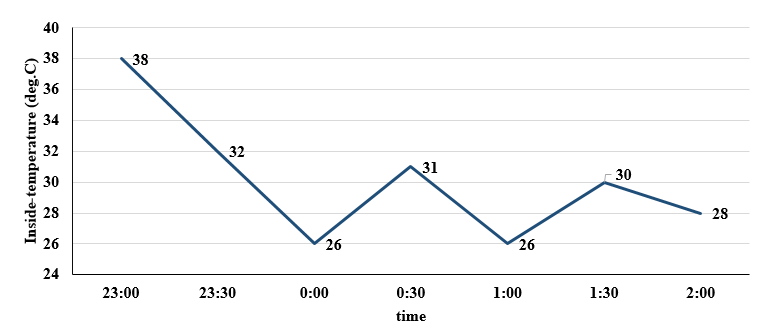
The temperature outside has been falling at a constant rate from 7 pm onward until 3 am on a particular night. The following graph shows the inside temperature between 11 pm (23:00)and 2 am (2:00) that night.
The following facts are known about the AC operation that night.
• The AC was turned on for the first time that night at 11 pm (23:00).
• The AC setting was changed (including turning it on/off, and/or setting different temperatures) only at the beginning of the hour or at 30 minutes after the hour.
• The AC was used in POWER mode for longer duration than in REGULAR mode during this 3-hour period.
23:00–0:00: 38 → 26 at a steady /hour.
0:00–0:30: AC off, 26 → 31. When off, the room rises to the outside temperature in 1 hour, so outside at 0:00 .
0:30–1:00: AC on, 31 → 26.
1:00–1:30: AC off, 26 → 30, so outside at 1:00 . Outside falls /hour (42 at 21:00).
1:30–2:00: AC on, 30 → 28.
Power mode must be used for longer than regular mode. If 23:00–0:00 were regular (60 min), power could total at most 60 min. So 23:00–0:00 is power mode: set 32 (reached at 23:30), then reset to 26 at 23:30.
How many times the AC must have been turned off between 11:01 pm and 1:59 am?
The AC was switched off at 0:00 and at 1:00: times.
What was the temperature outside, in degree Celsius, at 1 am?
C at 1 am.
What was the temperature outside, in degree Celsius, at 9 pm?
Outside falls per hour: 36 at midnight, so C at 9 pm.
What best can be concluded about the number of times the AC must have either been turned on or the AC temperature setting been altered between 11:01 pm and 1:59 am?
Changes after 23:00: reset at 23:30, on at 0:30, on at 1:30. Exactly .
What was the maximum difference between temperature outside and inside temperature, in degree Celsius, between 11:01 pm and 1:59 am?
At 0:00 the inside is 26 and outside 36: difference C, the largest in the period.
Odsville has five firms - Alfloo, Bzygoo, Czechy, Drjbna and Elavalaki. Each of these firms was founded in some year and also closed down a few years later.
Each firm raised Rs. 1 crore in its first and last year of existence. The amount each firm raised every year increased until it reached a maximum, and then decreased until the firm closed down. No firm raised the same amount of money in two consecutive years. Each annual increase and decrease was either by Rs. 1 crore or by Rs. 2 crores. The table below provides partial information about the five firms.
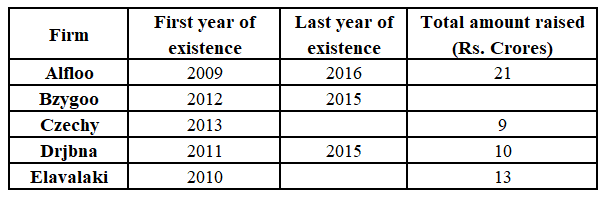
Each sequence starts and ends at 1, rises then falls, in steps of 1 or 2.
Drjbna (2011–15, total 10): only 1, 2, 4, 2, 1. Czechy (total 9, from 2013): only 1, 2, 3, 2, 1.
Bzygoo (2012–15): 1, 2, 3, 1 or 1, 3, 2, 1.
Alfloo (2009–16, total 21): 1, 2, 3, 4, 5, 3, 2, 1 or 1, 2, 3, 5, 4, 3, 2, 1.
Elavalaki (from 2010, total 13): 1, 2, 3, 4, 2, 1 or 1, 2, 4, 3, 2, 1 or 1, 3, 5, 3, 1.
For which firm(s) can the amounts raised by them be concluded with certainty in each year?
Only Czechy and Drjbna have a single possible sequence.
What best can be concluded about the total amount of money raised in 2015?
2015: Alfloo 2 (both options), Bzygoo 1, Czechy 3, Drjbna 1, Elavalaki 1 (6-year options) or 0 (closed in 2014).
Total or .
What is the largest possible total amount of money (in Rs. crores) that could have been raised in 2013?
2013 maximum: Alfloo 5 Bzygoo 3 Czechy 1 Drjbna 4 Elavalaki 4 .
If Elavalaki raised Rs. 3 crores in 2013, then what is the smallest possible total amount of money (in Rs. crores) that could have been raised by all the companies in 2012?
Elavalaki 3 in 2013 means 1, 2, 4, 3, 2, 1 (2012: 4) or 1, 3, 5, 3, 1 (2012: 5).
2012 smallest: Alfloo 4 Bzygoo 1 Drjbna 2 Elavalaki 4 (Czechy hadn't started).
If the total amount of money raised in 2014 is Rs. 12 crores, then which of the following is not possible?
With a 2014 total of 12, the only consistent combinations never give Bzygoo and Elavalaki equal amounts in 2013. So A is not possible.
A few salesmen are employed to sell a product called TRICCEK among households in various housing complexes. On each day, a salesman is assigned to visit one housing complex. Once a salesman enters a housing complex, he can meet any number of households in the time available. However, if a household makes a complaint against the salesman, then he must leave the housing complex immediately and cannot meet any other household on that day. A household may buy any number of TRICCEK items or may not buy any item. The salesman needs to record the total number of TRICCEK items sold as well as the number of households met in each day. The success rate of a salesman for a day is defined as the ratio of the number of items sold to the number of households met on that day. Some details about the performances of three salesmen - Tohri, Hokli and Lahur, on two particular days are given below.
1. Over the two days, all three of them met the same total number of households, and each of them sold a total of 100 items.
2. On both days, Lahur met the same number of households and sold the same number of items.
3. Hokli could not sell any item on the second day because the first household he met on that day complained against him.
4. Tohri met 30 more households on the second day than on the first day.
5. Tohri’s success rate was twice that of Lahur’s on the first day, and it was 75% of Lahur’s on the second day.
Lahur: same each day, 100 items in total, so 50 items a day. Say he met households a day ( in all).
Hokli: on Day 2 he met 1 household and sold nothing, so he sold all 100 on Day 1.
Tohri: households on Day 1 and on Day 2 (total ), selling and .
Equal totals: , so .
Day 1: . Day 2: .
Adding: .
| Day 1 met | Day 1 sold | Day 2 met | Day 2 sold | |
|---|---|---|---|---|
| Tohri | 10 | 40 | 40 | 60 |
| Hokli | 49 | 100 | 1 | 0 |
| Lahur | 25 | 50 | 25 | 50 |
What was the total number of households met by Tohri, Hokli and Lahur on the first day?
.
How many TRICCEK items were sold by Tohri on the first day?
.
How many households did Lahur meet on the second day?
, between 21 and 29.
How many households did Tohri meet on the first day?
: 10 or less.
Which of the following statements is FALSE?
Day 2 rates: Tohri , Hokli , Lahur . Lahur, not Tohri, was highest, so A is false.
(Day 1: Tohri 4, Hokli , Lahur 2, so C and D are true; B is true as .)
All the first-year students in the computer science (CS) department in a university take both the courses (i) AI and (ii) ML. Students from other departments (non-CS students) can also take one of these two courses, but not both. Students who fail in a course get an F grade;others pass and are awarded A or B or C grades depending on their performance. The following are some additional facts about the number of students who took these two courses this year and the grades they obtained.
1.The numbers of non-CS students who took AI and ML were in the ratio 2 : 5.
2.The number of non-CS students who took either AI or ML was equal to the number of CS students.
3.The numbers of non-CS students who failed in the two courses were the same and their total is equal to the number of CS students who got a C grade in ML.
4. In both the courses, 50% of the students who passed got a B grade. But, while the numbers of students who got A and C grades were the same for AI, they were in the ratio 3 :2 for ML.
5. No CS student failed in AI, while no non-CS student got an A grade in AI.
6.The numbers of CS students who got A, B and C grades respectively in AI were in the ratio 3 : 5 : 2, while in ML the ratio was 4 : 5 : 2.
7.The ratio of the total number of non-CS students failing in one of the two courses to the number of CS students failing in one of the two courses was 3 : 1.
8. 30 students failed in ML.
Let there be CS students (taking both courses). Non-CS: AI , ML , with .
CS in AI: grades A : B : C , nobody fails. CS in ML: pass, fail.
Non-CS failures: in each course, and CS ML C-grade , so .
Failures: non-CS : CS .
ML failures: , , .
AI: 210 CS 60 non-CS . ML: 210 CS 150 non-CS .
ML passed : B 165, A 99, C 66. CS: A 72, B 90, C 36, so non-CS: A 27, B 75, C 30.
AI passed : B 126, A C . CS: A 63, B 105, C 42, so non-CS: A 0, B 21, C 21.
How many students took AI?
.
How many CS students failed in ML?
.
How many non-CS students got A grade in ML?
.
How many students got A grade in AI?
All 63 A grades in AI went to CS students: .
How many non-CS students got B grade in ML?
.
Ganga, Kaveri, and Narmada are three women who buy four raw materials (Mango, Apple, Banana and Milk) and sell five finished products (Mango smoothie, Apple smoothie, Banana smoothie, Mixed fruit smoothie and Fruit salad). Table-1 gives information about the raw materials required to produce the five finished products. One unit of a finished product requires one unit of each of the raw materials mentioned in the second column of the table.
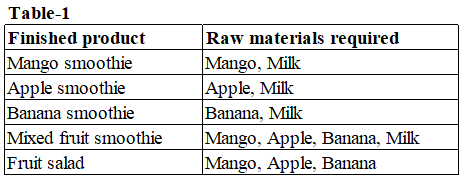
One unit of milk, mango, apple, and banana cost ₹5, ₹3, ₹2, and ₹1 respectively. Each unit of a finished product is sold for a profit equal to two times the number of raw materials used to make that product. For example, apple smoothie is made with two raw materials (apple and milk) and will be sold for a profit of ₹4 per unit. Leftover raw materials are sold during the last business hour of the day for a loss of ₹1 per unit.
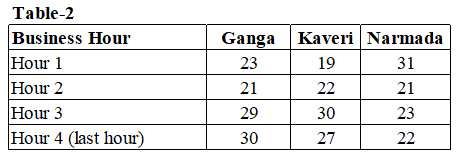
The amount, in rupees, received from sales (revenue) for each woman in each of the four business hours of the day is given in Table-2.
The following additional facts are known.
1. No one except possibly Ganga sold any Mango smoothie.
2. Each woman sold either zero or one unit of any single finished product in any hour.
3. Each woman had exactly one unit each of two different raw materials as leftovers.
4. No one had any banana leftover.
Price cost profit. Mango smoothie , Apple smoothie , Banana smoothie , Mixed , Fruit salad .
Leftovers sell at cost : milk 4, mango 2, apple 1. Each woman sells two different non-banana leftovers in Hour 4: milk + mango 6, milk + apple 5, or mango + apple 3.
Each hour's revenue must be a sum of distinct products (Mango smoothie only for Ganga):
| Hour | Ganga | Kaveri | Narmada |
|---|---|---|---|
| 1 | AS + (MS or FS) | MX | MX + FS |
| 2 | BS + AS | BS + FS | BS + AS |
| 3 | MX + BS | MX + AS | AS + FS |
| 4 | MS + FS | BS + AS or BS + FS | MX |
Leftovers: Ganga milk + mango; Narmada mango + apple; Kaveri milk + mango or milk + apple.
What BEST can be concluded about the number of units of fruit salad sold in the first hour?
Hour 1: Narmada sold one fruit salad; Ganga sold either a fruit salad or a mango smoothie; Kaveri none. Either 1 or 2.
Which of the following is NECESSARILY true?
Ganga's leftovers are milk and mango, so she sold no leftover apple.
What BEST can be concluded about the total number of units of milk the three women had in the beginning?
Milk used (MS, AS, BS, MX) plus leftover milk:
Ganga or , or . Kaveri or or . Narmada .
Total: 18, 19 or 20.
If it is known that three leftover units of mangoes were sold during the last business hour of the day, how many apple smoothies were sold during the day?
Three mango leftovers means Kaveri's are milk + mango, so her Hour 4 is BS + AS.
Apple smoothies: Ganga 2, Kaveri 2, Narmada 2 .
The local office of the APP-CAB company evaluates the performance of five cab drivers, Arun, Barun, Chandan, Damodaran, and Eman for their monthly payment based on ratings in five different parameters (P1 to P5) as given below:
P1: timely arrival
P2: behaviour
P3: comfortable ride
P4: driver's familiarity with the route
P5: value for money
Based on feedback from the customers, the office assigns a rating from 1 to 5 in each of these parameters. Each rating is an integer from a low value of 1 to a high value of 5. The final rating of a driver is the average of his ratings in these five parameters. The monthly payment of the drivers has two parts - a fixed payment and final rating-based bonus. If a driver gets a rating of 1 in any of the parameters, he is not eligible to get bonus. To be eligible for bonus a driver also needs to get a rating of five in at least one of the parameters. The partial information related to the ratings of the drivers in different parameters and the monthly payment structure (in rupees) is given in the table below:
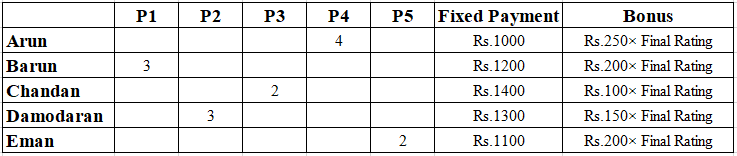
The following additional facts are known.
1. Arun and Barun have got a rating of 5 in exactly one of the parameters. Chandan has got a rating of 5 in exactly two parameters.
2. None of drivers has got the same rating in three parameters.
Bonus needs no 1 and at least one 5. No rating may appear in three parameters (so at most twice).
Known: Arun P4 (one 5), Barun P1 (one 5), Chandan P3 (two 5s), Damodaran P2 , Eman P5 .
Payment fixed multiplier final rating.
If Damodaran does not get a bonus, what is the maximum possible value of his final rating?
Without a 5: best is (3.2). With a 5 but a 1: , i.e. .
If Eman gets a bonus, what is the minimum possible value of his final rating?
No 1, at least one 5, P5 : lowest is , i.e. .
If all five drivers get bonus, what is the minimum possible value of the monthly payment (in rupees) that a driver gets?
Lowest ratings with bonus:
Arun → . Barun → . Chandan → . Damodaran → . Eman → .
Minimum: 1700.
If all five drivers get bonus, what is the maximum possible value of the monthly payment (in rupees) that a driver gets?
Highest ratings with bonus:
Arun → . Barun → . Chandan → . Damodaran → . Eman → .
Maximum: 1960.
Preparing for CAT seriously? Structured courses, live classes and mocks by Dr. Kiran Derle at Target Campus.
Explore courses ↗